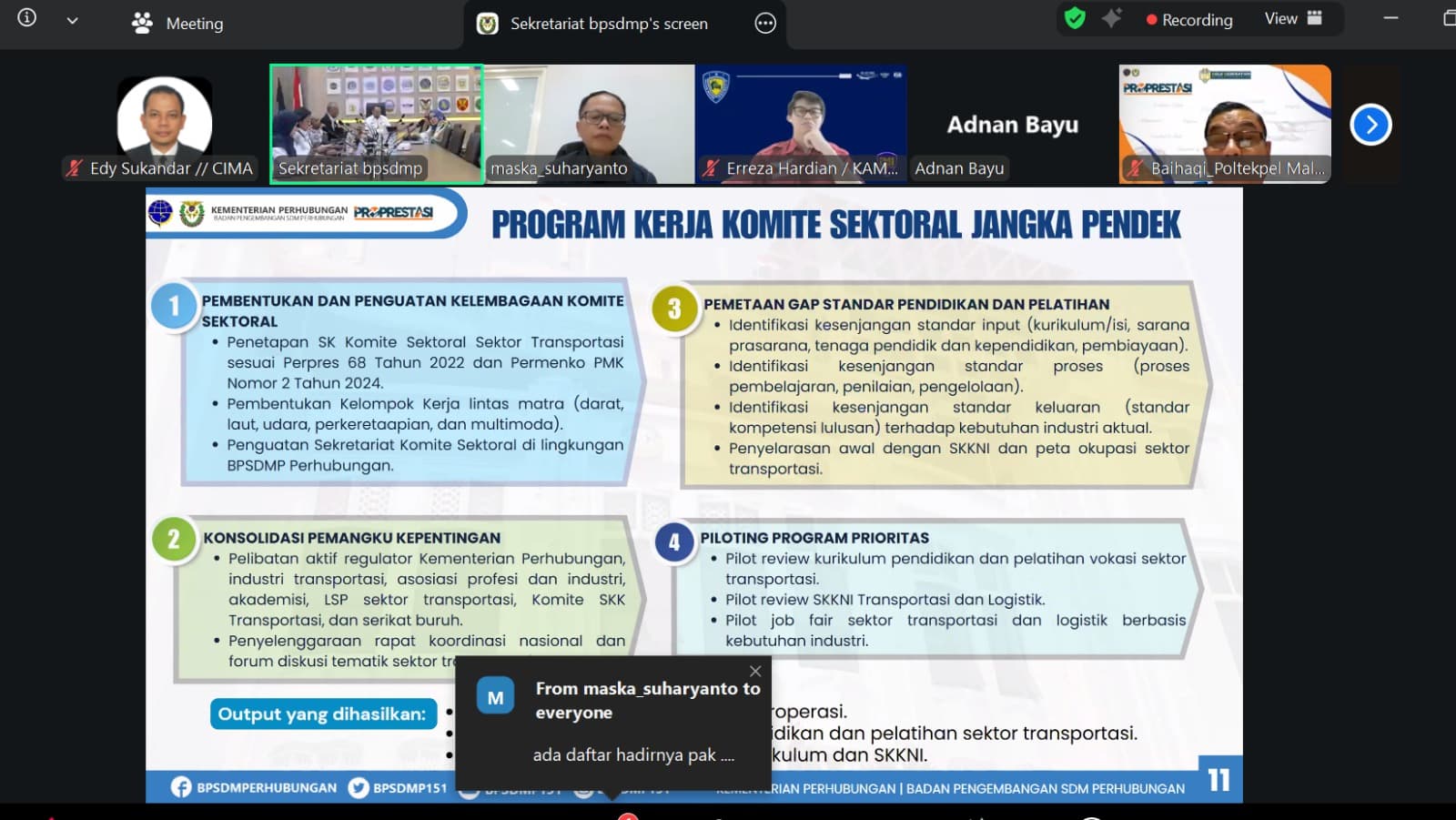
Jakarta, 9 February 2026 — CIMA attended an official invitation from the Human Resources Development Agency (BPSDM) for Transportation at the Ministry of Transportation of the Republic of Indonesia, at a briefing on the formation of a Transport Sectoral Committee held online together with stakeholders from the national transport sector.
The event formed part of the government's strategic steps to strengthen the governance of education, training and competency development for transport human resources through the formation of a Transport Sectoral Committee, as mandated by Presidential Regulation 68 of 2022 and Coordinating Ministry Regulation PMK No. 2 of 2024.
In setting out its short-term work programme, BPSDM presented four priority agendas:
1. Forming and strengthening the sectoral committee's institutional basis, including setting the committee structure, establishing cross-modal working groups (land, sea, air, rail and multimodal), and strengthening the committee secretariat.
2. Consolidating stakeholders by involving regulators, the transport industry, professional associations, academics, professional certification bodies (LSP), and representatives of business and labour, so that cross-sector collaboration runs effectively.
3. Mapping gaps in education and training standards, by identifying shortfalls in the input, process and output of learning and aligning them with the national competency standards (SKKNI) and actual industry needs.
4. Delivering priority programmes as pilot projects, covering a review of transport vocational curricula, refinement of SKKNI for the transport and logistics sector, and holding a job fair based on industry demand.
CIMA's participation in this forum is an expression of the association's active commitment to supporting a stronger ecosystem for the nation's maritime and transport human resources, particularly in aligning the competence of seafarers and the manning industry with industry standards and global demand.
CIMA regards the formation of the Sectoral Committee as an important step towards an education and training system that is more integrated, more adaptable, and better aligned with technological change and the demands of the international labour market.
Through collaboration between government, industry and professional associations, it is hoped that the quality of Indonesia's transport human resources will become more competitive and better able to meet the challenges facing the global transport sector in the years ahead.